
Last Updated on April 30, 2026
Greetings, humans!

Allow me to stretch my wings and welcome you to the wonderful world of native herons. My name is Heronimo and I’m a proud Great Blue Heron, one of that call the big, beautiful state of Texas home. I’m also one of the River Authority’s Basin Besties, and I’ve got a big job — keeping our San Antonio River Basin safe! You may have spotted me gliding over marshes, stalking along riverbanks, or settling into one of our lofty treetop neighborhoods. We call those nesting colonies rookeries, and trust me, they’re the original high-rise apartments.
Now, if you see me in the wild, be careful not to come too close! We’re protected under the Migratory Bird Treaty Act, which means humans are required to admire us respectfully from a distance. A wise rule, if you ask me.
But why all this fuss about herons, anyway?
Because we’re more than just photogenic fishermen; we help keep ecosystems in balance by managing populations of fish, insects, amphibians, and even small mammals. Our presence is a sign of healthy wetlands, and when wetlands thrive, everything from water quality to biodiversity gets a boost. Think of us as nature’s quiet caretakers, long‑legged stewards of the shoreline.
So, settle in, friends. I’ve got stories to tell, snacks to catch, and plenty of reasons why life is better with a heron, or twelve, nearby.
Great Blue Heron

Photo Credit: Salem De La Luna (iNaturalist CCBY)
Let’s start with me, the Great Blue Heron!

As the biggest herons in North America, we stand over four feet tall. Despite our impressive stature, we only weigh 5 to 6 pounds because we, like all birds, have hollow bones to make flying easier. We get our name from the light blue-gray feathers along our wings and back. You can also spot us by looking for our bright orange-yellow beak and a long black stripe across the top of our head. People hunted us for our feathers during the late 19th and early 20th centuries, but because of things like the Migratory Bird Treaty Act, our populations are now stable.

Photo Credit: Nick Lavoie (iNaturalist CCBY)
You can spot us all along the creeks and rivers of the San Antonio River Watershed. We are not particularly picky when looking for habitat; if there is water and something to snack on, we’ll be there! Often, you can see us slowly stalking fish, our favorite food! When hunting, we use our sharp, knife-like beak to stab prey, which can also include small mammals, amphibians, insects, reptiles, and more.
Yellow-crowned Night Heron
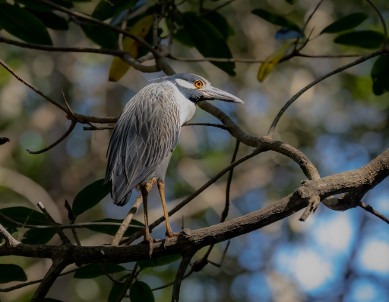
Photo Credit: Derek Spencer (iNaturalist CCBY)
Next up, we will visit our friend, the Yellow-crowned Night Heron! Unlike most herons, these little guys are short and stout. With short legs and neck, a small stubby beak, and an average height of 2 feet, they are much smaller than us Great Blue Herons. Keep your eyes peeled for their black and white face, purple-gray feathers, and long yellow ornamental feathers atop their head. Typically, these small herons hang out around marsh habitats. No matter where you are, they might be harder to spot than other herons because they are solitary, secretive birds. Their elusive nature makes it hard to accurately assess their population size. However, scientists believe their populations are healthy and relatively stable, making them a species of low conservation concern.

Photo Credit: River Clicks Photo Contest 2022
The Yellow-crowned Night Heron’s diet is composed almost entirely of small crustaceans like crabs and crayfish. Their acidic stomachs dissolve the shells of their prey, making them an easy meal. Rather than a specific time of day, their foraging is dictated by the tides. They are most active during the three hours before and after high tide, so if you want to spot them, this would be your best bet!
Green Heron

Photo Credit: Chrissy McClarren and Andy Reago (iNaturalist CCO)
Finally, we will pay the Green Heron a visit. Like Yellow-crowned Night Herons, Green Herons are small and stocky. From a distance, their green and brown feathers blend in with the leaves and brush they like to hide by. If you get the opportunity to see one up close, you will surely be impressed with their velvety green plumage, black crested head, and soft brown belly. Green Herons are solitary creatures, preferring to hunt fish alone. They are smart hunters! One of the few birds to utilize tools, they use insects and plant material to lure their prey before striking with their sharp beak. Very few birds use tools to hunt, so their ingenuity is impressive!

Photo Credit: Dario Taraborelli (iNaturalist CCO)
While the Green Herons are the most widespread heron species in Texas, their population is rapidly declining. Issues like urbanization and wetland draining threaten their habitat, so it is important that we keep their remaining habitat clean and protected so that they can continue to thrive. Keep a lookout next time you are near a marshy body of water; you might be lucky enough to see these elusive birds!

Thank you for joining me in exploring some of our native herons — I hope this information didn’t fly over your head! (Just kidding!) Always remember to keep wildlife wild by not approaching or feeding any wildlife you come across. If you’re interested in helping protect the river I call home, think about joining our River Warrior Volunteer program to help keep our rivers clean!